
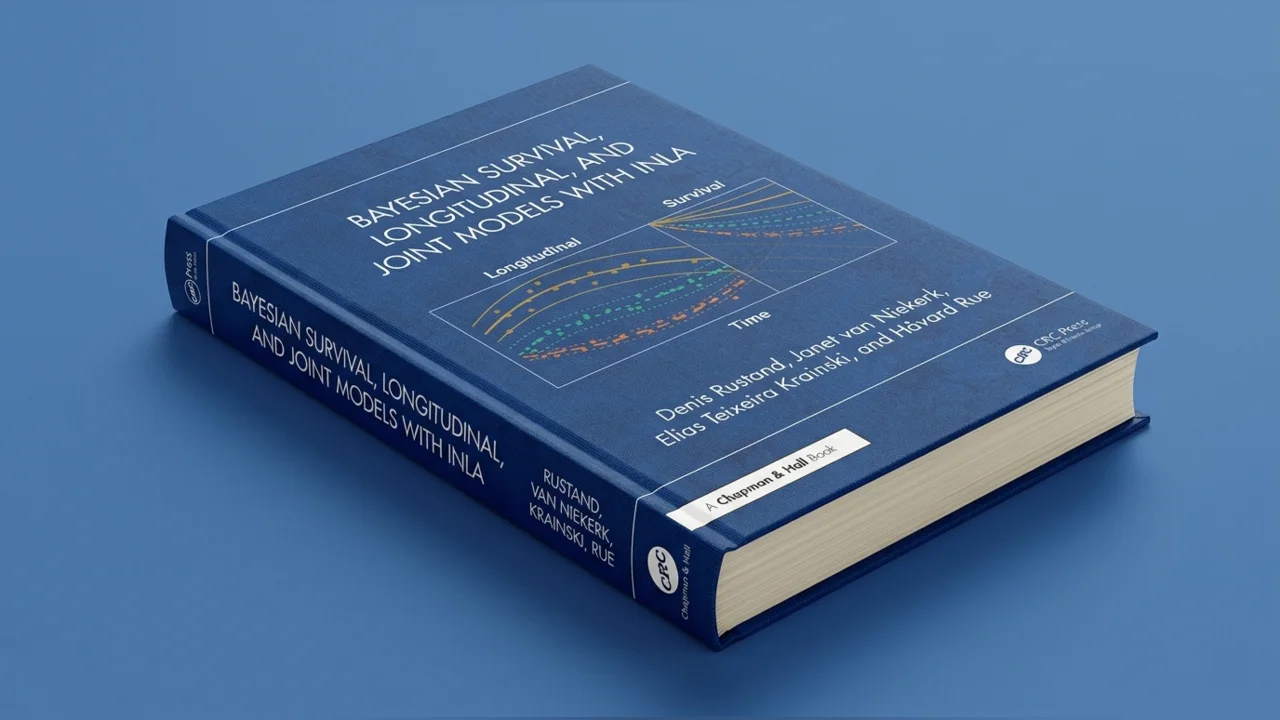
INLA Team Publishes New Book on Joint Survival and Longitudinal Modelling
We are thrilled to announce the publication of our latest book, a comprehensive guide to fitting complex Bayesian survival, longitudinal, and joint models using the Integrated Nested Laplace Approximations (INLA) methodology. This highly anticipated release represents a major milestone for our team, offering a powerful, computationally efficient alternative to traditional MCMC methods for researchers around the globe.
About
Overcoming Computational Hurdles
Aimed at graduate students, applied statisticians, and researchers in biostatistics, epidemiology, and public health, this book directly tackles the critical challenge of analyzing high-dimensional and correlated data. Through clear, fully reproducible examples, readers are empowered to implement a wide array of survival models, fit diverse longitudinal models, and construct intricate joint models linking multiple markers. Furthermore, it details how to seamlessly incorporate spatial random effects to account for autocorrelation, enabling the scientific community to analyze sophisticated models that were previously out of computational reach.
A Unique Collaboration
This publication is the culmination of exceptional teamwork by the creators and key developers of the INLA methodology. The project is spearheaded by lead author Denis Rustand, former postdoctoral fellow in the BAYESCOMP group and developer of the INLAjoint R package. He is joined by our very own Håvard Rue, the principal architect of the INLA methodology and R-INLA package, alongside Janet van Niekerk, previously research scientist at BAYESCOMP and an expert in efficient Bayesian methods for complex survival analysis, and renowned spatial statistics specialist Elias Teixeira Krainski.
Taking INLA to the Global Stage
The impact of our team's work is already resonating internationally. We are incredibly excited to share that the methodologies and insights from the book will be taught at the upcoming 9th València International Bayesian Analysis Summer School (VIBASS9). This prominent global engagement underscores our research group's ongoing commitment to advancing Bayesian statistics, expanding our international connections, and equipping the next generation of scientific leaders with cutting-edge analytical tools.
Related People
Denis Rustand
- Postdoctoral Research Fellow (former), Statistics

Janet van Niekerk
- Research Scientist (former), Statistics